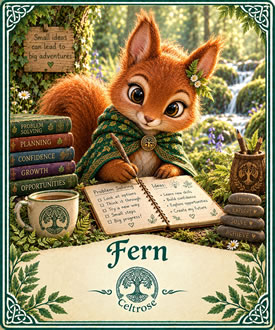
🐿️ The Story of Fern
Fern was one of the busiest creatures in the woodland, She was always collecting things : Acorns, Seeds, Interesting little pieces of bark, Feathers, Twigs, Bits of string that other creatures had overlooked.
Nobody quite understood why Fern kept all these things - Until one day, something happened . . .
The bridge across the woodland stream had been damaged by a storm - Everyone gathered around, wondering what to do ?
Fern looked at the things she had collected - She looked at the broken bridge.
And then she said :
“I think we might already have what we need.”
“Fern is our resourceful little problem-solver, always finding another way and reminding us that there is more than one route to where we want to go.”
🌿 Fern sees what is already there
Fern had a wonderful ability - She noticed things that other people overlooked :
Small strengths.
Useful experiences.
Skills someone didn’t realise they had.
Different ways of solving a problem.
Something someone had learned outside of formal education.
Ideas they had developed on simply because they had needed to.
Fern understood that people don’t arrive empty-handed - They bring things with them.
Personal experiences.
Their knowledge.
Interests & Hobbies
Different ways of thinking.
Their creativity.
Resilience overcoming situations.
Lived experience of neuro-divergence.
Importantly their strengths.
🐿️ When Fern met Rowyn
When Fern first met Rowyn, she asked : “What are you good at ?”
Rowyn shrugged - “I don’t know.” - Fern didn’t immediately start listing things Rowyn needed to improve.
Instead, she became curious . . .
“What do people come to you for help with ?”
Rowyn thought for a moment - “Actually . . . People often ask me to help them with that.”
Fern smiled - “That’s interesting. What makes you good at it ?”
Rowyn began to think - And slowly, Rowyn started noticing strengths that had previously felt ordinary.
🌱 Fern and the hidden strengths
Fern became particularly good at helping the Woodland Family discover the things they had stopped noticing about themselves.
She knew that sometimes a strength doesn’t look like a traditional skill.
Being observant can be a strength.
Knowing when something doesn’t feel right can be a strength.
Finding a different solution can be a strength.
Understanding other people’s experiences can be a strength.
Being persistent can be a strength.
Knowing when you need help can be a strength.
And sometimes something that had previously been described as a difficulty could also contain a strength.
Fern never assumed that every difficulty was secretly a superpower.
Instead, she asked :
“What does this tell us about how you work best ?”
💚 Why Fern belongs with Celtrose
Fern represents strengths-based mentoring - She reminds mentors that a mentoring conversation can too easily begin with :
“What do you need to improve ?”
when perhaps it could begin with :
“What are you already bringing with you ?”
That doesn’t mean ignoring development needs - It means using strengths as a starting point for development rather than defining someone by their difficulties.
Fern is also a lovely link to your Capability Approach because the question isn’t simply :
“What can this person do ?”
But : “What opportunities and conditions would allow this person to use and develop what they can do ?”
🐿️ Fern - The Strength Spotter
“Fern reminds us that people often bring more with them than they realise. Our role isn’t to tell someone what their strengths are, but to help them notice, understand and use the capabilities they already have.”
And Fern’s little motto :
“Look at what you already have.”

“It's not what you achieve, it's what you overcome - That's what defines your career"
Carlton Fisk